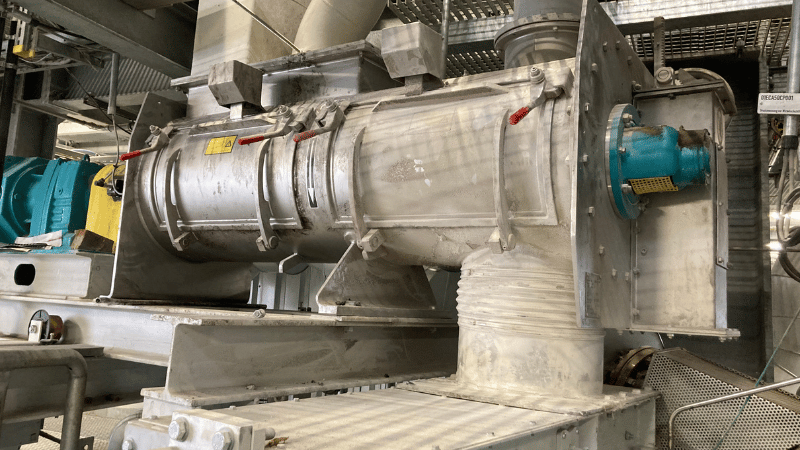
Zirngibl, a private waste disposal company based in southern Bavaria, Germany is expanding its range of services with a new mono-incineration plant for sewage sludge. The company uses a LÖDIGE mixer of type KM 300 DW for precise conditioning prior to incineration.
The company Zirngibl based in southern Bavaria, Germany is establishing itself as a regional waste disposal company. Its focus has always been on processing sewage sludge into dry matter. The company is now expanding its range of services to include subsequent incineration, taking on more responsibility for the environment and the surrounding communities. Rather than transporting the sewage sludge over long distances for incineration after drying, it is now treated on site in a new mono-incineration plant that recovers phosphorus.
Sewage sludge conditioning for optimal results
To optimise the thermal process, the sewage sludge has to be conditioned before incineration. The focus is on the dry substance content (DS). This is crucial for the operation of incineration plants in general, but especially for those treating thermal biomass. DS content refers to the proportion of material remaining after water has been removed, expressed as a percentage.
For the operation of an incineration plant, the significance of the DS content primarily concerns the combustion rate and energy content: the higher the DS content, the greater the amount of solid fuel (organic matter) present, which increases efficiency and calorific value. Additionally, the DS content impacts emission control in incinerators.
Therefore, a specific mixing ratio of wet and dried sewage sludge, as well as good homogeneity, are crucial for optimal thermal utilisation. The structure of the material must also meet certain requirements: a defined particle size must be achieved for an optimal thermal process.
As a technology manufacturer with extensive knowledge of the process, LÖDIGE experienced that achieving homogeneous mixing of wet and dried sewage sludge was not the deciding factor in this case and that the back mixing of moist and dried components on the product surface was required instead. This particularity has been made possible by specific process adjustments.
Precise pre-treatment in a Ploughshare® Mixer
Mixing and structuring in a continuous LÖDIGE Ploughshare® Mixer of type KM 300 DW proved to be an effective method of conditioning the sewage sludge. This mixer has a drum volume of 300 litres, corresponding to a filling level of 50 per cent. During the mixing process, the mixer is continuously fed with wet and partially dried sewage sludge via an automated transport device.
The machine is based on the fluid bed process that LÖDIGE introduced into to industrial mixing technology, ensuring excellent mixing. Specially developed Ploughshare® Shovels rotate close to the wall in a horizontal drum to create a fluid bed of product. These shovels have a serrated design that is well-suited to this application and are fitted with an additional wear protection on the edges and sides.
Learn more about the Ploughshare® Mixer for continuous operation
A challenging product requires suitable technology
The fluid bed process enables a high degree of homogeneity and consistent reproducibility as well as low mechanical energy input. It therefore provides the ideal conditions for achieving a consistency suitable for conveyance. The sludge to be mixed is challenging in terms of technology as it is viscous and almost dough-like in the so-called glue phase.
For this reason, a conventional mixing screw is not suitable as it tends to “knead” the product causing blockages. On the contrary, a mixer operating according to the fluid bed ensures the back mixing of wet sludge with dried sludge on the product surface. In the next stage, the product passes through a short screw conveyor before being transferred to the furnace by a scraper wheel.
Conclusion
Thanks to the use of a LÖDIGE Ploughshare® Mixer, conditioning sewage sludge in the mono-incineration plant of the waste disposal company Zirngibl has been running smoothly since the plant went into operation in 2024. The south Bavarian company has expanded its services in the region in a meaningful way, while complying with the legal requirements regarding phosphorus recovery.